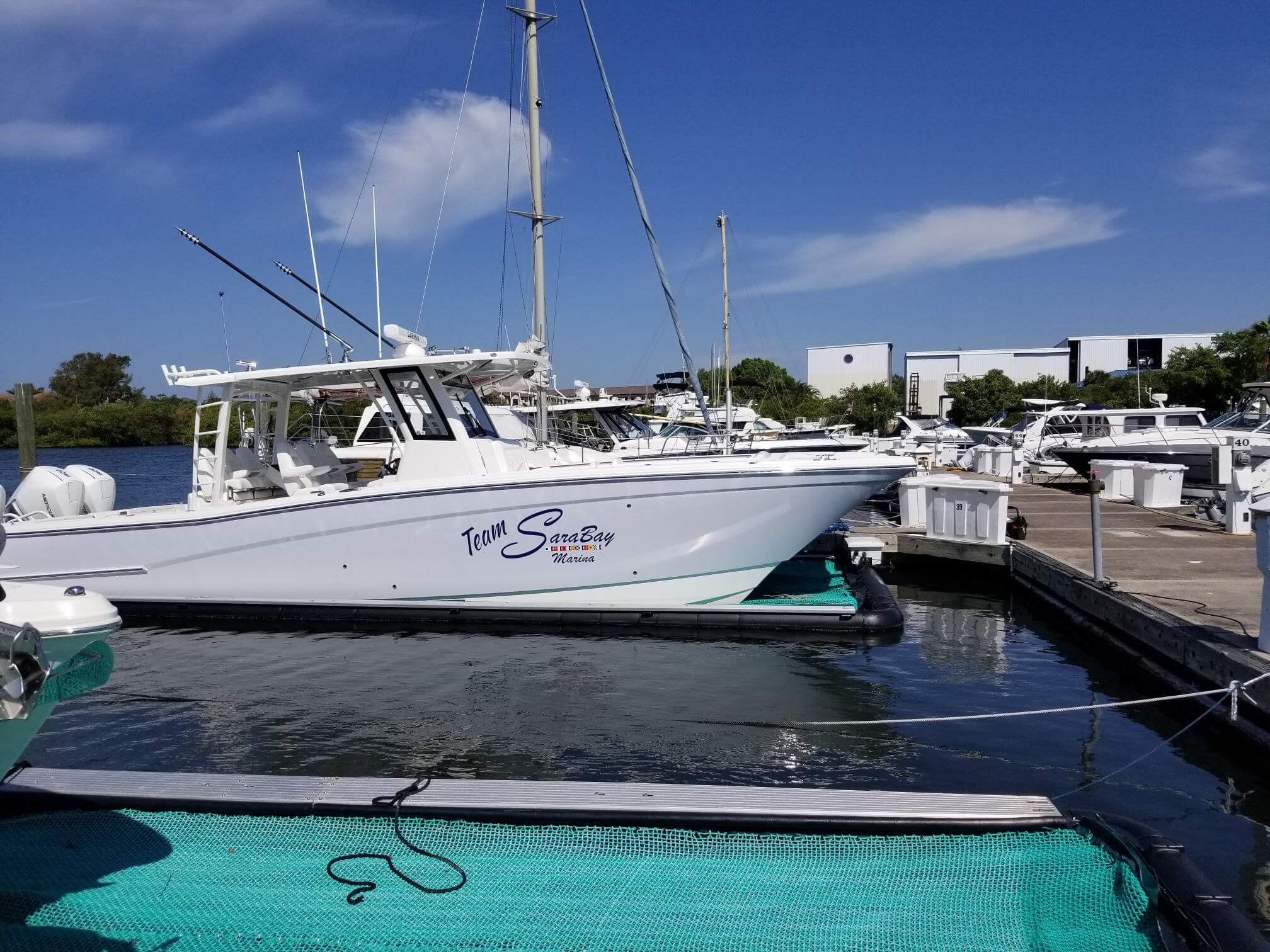
Marine vinyl graphics last significantly longer when you wash them monthly with a marine-safe soap, apply UV protectant every quarter, keep pressure washer nozzles away from graphic edges, and address any lifting or bubbling as soon as it appears. Saltwater, UV exposure, and humidity are relentless in Florida, but a consistent maintenance routine can extend the life of your boat graphics by years. Here is everything you need to know, drawing on our 50-plus years of marine vinyl expertise.
How Often Should You Wash Boat Graphics?
Monthly washing is the baseline. If your boat operates in saltwater, post-trip freshwater rinses are even more important. Salt crystals left on vinyl surfaces act as a mild abrasive and a hygroscopic agent — they attract and hold moisture against the vinyl surface, accelerating adhesive breakdown at the edges. A thorough freshwater rinse after every saltwater outing takes five minutes and prevents months of cumulative damage.
For your monthly deep clean, use a marine-safe soap — products designed for gel coat and marine surfaces are vinyl-friendly because they avoid harsh solvents and abrasive compounds. Apply the soap with a soft sponge or microfiber wash mitt, working gently across the graphics. Avoid stiff-bristle brushes, scouring pads, or any abrasive tool. Marine vinyl is durable against environmental exposure but can be scratched by aggressive mechanical cleaning.
Pay special attention to the edges of the graphics during washing. This is where contaminants accumulate and where failure begins. Gently clean along the edges to remove salt, dirt, and biological growth without lifting the vinyl. If you notice a small area where the edge has begun to separate from the hull, do not scrub at it — clean around it gently and schedule a repair before water intrusion worsens the problem.
Why Is UV Protectant Important for Marine Vinyl?
Florida's marine environment delivers a double dose of UV radiation — direct sunlight from above and reflected UV from the water surface below. This constant bombardment degrades the plasticizers in vinyl, causing it to become brittle, crack, and fade. A quarterly application of marine-grade UV protectant replenishes the surface protection and slows this degradation significantly.
Choose a UV protectant specifically formulated for marine vinyl. Products like 303 Aerospace Protectant or similar marine-specific treatments provide UV filtering without leaving a greasy residue that could undermine adhesive bonds at graphic edges. Apply the protectant to the face of the graphics only — avoid saturating the edges, as excess product can wick under the vinyl and weaken the adhesive.
Apply the protectant after washing, when the surface is clean and dry. Spray or wipe it on evenly, allow it to absorb for the time specified on the product label, then buff off any excess with a clean microfiber cloth. Quarterly application in Florida's climate provides a good balance of protection and maintenance effort. Boats stored outdoors year-round or used in extremely high-UV environments may benefit from bimonthly application.
Can You Use a Pressure Washer on Boat Graphics?
You can use a pressure washer on the broad, flat surfaces of your graphics at a reduced pressure setting and a wide fan nozzle — but never aim the concentrated stream directly at graphic edges, seams, or any area where lifting has already begun. High-pressure water can penetrate under the edge of the vinyl, breaking the adhesive bond and causing the graphic to peel away from the hull.
A safe approach is to use a pressure washer with a 40-degree fan tip at no more than 1,500 PSI, keeping the nozzle at least twelve inches from the surface. Spray parallel to the graphic edges rather than perpendicular to them. For the edges themselves, switch to a garden hose or hand wash. This approach lets you use pressure washing to efficiently clean the hull while protecting the vulnerable transition zones where vinyl meets gel coat.
What Should You Do When Graphics Start Lifting or Bubbling?
Address lifting and bubbling immediately — these problems only worsen with time. A small area of edge lifting, if caught early, can often be repaired by a professional with adhesive promoter and a heat gun in under an hour. Left untreated, water intrusion spreads under the graphic, the adhesive fails across a larger area, and the entire graphic may need to be replaced.
Air bubbles that appear after installation are usually caused by trapped air or outgassing from the hull surface. Small bubbles (under a quarter inch) often resolve themselves as the vinyl settles, especially in warm weather. Larger bubbles or bubbles that appear months after installation should be evaluated by a professional — they may indicate adhesive failure or moisture intrusion.
Do not attempt to puncture bubbles with a pin or razor blade. While this is an acceptable technique for trained installers working with specific film types, an imprecise puncture can create a tear that grows over time, especially under the stress of marine use. Let a professional assess and repair the issue with the right tools and materials.
How Do Storage and Trailering Affect Marine Graphics?
Boats stored on trailers with bunks or rollers that contact graphic areas are at risk for abrasion damage during loading, unloading, and road vibration. If your trailer contacts the hull in areas where graphics are applied, consider adding protective padding to the bunks or repositioning the supports to avoid the graphic zones.
For boats stored outdoors, a fitted cover is the single best investment for preserving graphics (and every other surface on the boat). A cover blocks UV exposure, prevents rain and dew from sitting on graphic surfaces, and keeps biological contaminants like bird droppings and tree sap off the vinyl. If a full cover is not practical, even a partial cover over the graphics-heavy areas of the hull provides meaningful protection.
Indoor storage in a covered facility or garage eliminates UV and weather exposure entirely. Boats stored indoors consistently show the longest graphic lifespan. If indoor storage is available to you, use it.
When Should You Replace Marine Graphics Instead of Repairing Them?
If your graphics show widespread fading, cracking, edge failure across more than twenty percent of the total graphic area, or the vinyl has become brittle to the touch, replacement is more cost-effective than repair. Patching heavily degraded graphics creates a visible mismatch in color and texture that looks worse than the original problem.
Replacement is also the right call when your branding, registration numbers, or design has changed. Rather than layering new graphics over old ones — which creates adhesion problems and an uneven surface — remove the old graphics completely, prep the hull surface, and apply fresh material.
At Auto Trim Design of Suncoast, we have been producing and installing marine graphics for over five decades. From boat names and registration numbers to full hull wraps and custom designs, we use marine-grade vinyl and application techniques specifically developed for the harsh saltwater environment. Bring your boat to our Bradenton facility or ask about our mobile service for larger vessels. We will get your boat looking sharp and keep it that way.